

Visiting Keswick?
What makes Keswick one of the best places to visit in the Lake District?
Situated between the great bulk of Skiddaw and the gentle beauty of Derwentwater, Keswick is a charming market town in the heart of the Lake District National Park.
With magnificent scenery, easy access to famous fells, and a long tradition of welcoming visitors, it has been drawing travellers for more than 250 years.
Keswick is a charming market town in the heart of the Lake District National Park in Cumbria, England.
It is situated between the huge bulk of Skiddaw and the gentle beauty of Derwentwater.
Keswick has an embarrassment of walking riches.
Not only are there a host of fine hills such as Catbells, Blencathra and Helvellyn all just a short bus ride away, but there’s varied woodland and lakeside walking from the town itself.
Tourists have been visiting the Keswick area for over 250 years.
Initially, tourists primarily visited ‘viewing stations’ to admire the landscape from a distance.
However, they soon grew more adventurous. Local shoemakers developed higher-quality boots for walks and rock climbers.
The town itself was opened up to tourism for the first time during the eighteenth century with the creation of turnpikes that ran throughout the Lakes.
Nestled amidst the stunning scenery of the Lake District, Keswick is a popular destination for visitors seeking to experience the great outdoors, offering numerous opportunities for hiking, cycling, climbing, and water sports.

One of the best things about Keswick is its location. Surrounded by some of the most beautiful scenery in England, the town is the perfect base for exploring the Lakes.
To the south are the wooded surrounds of Derwent Water, which lead to the volcanic rock of Borrowdale.
To the north is the great hulk of Skiddaw, built on the softer, smoother slate.
From the top of Skiddaw, the Scottish hills and the Isle of Man can be seen from the summit on a clear day.
In the nineteenth century, the town was served by the Cockermouth, Keswick and Penrith railway, which began its service in 1865, with the route finally closing in 1972.

Keswick to Threlkeld Railway Trail
The Keswick to Threlkeld Railway Trail is a 5km level disability-friendly route along the old railway line.

To the east lies the Helvellyn range, easily accessible from Keswick.
Derwent Water
Derwent Water is typical of everything beautiful in the Lake District.
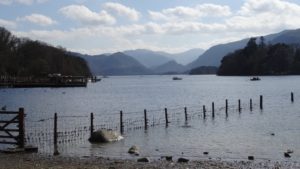
The lake is ringed by mountains and is dotted with islands that can be reached by one of the ferries that ply the stretches between the seven landing stages around the lake.
Whether you’re looking to hike up one of the many fells in the area, such as Skiddaw, Blencathra or Catbells, or take a leisurely stroll along the shores of Derwentwater, there’s something for everyone in Keswick.
Other Keswick Attractions
Other attractions close by are Ashness Bridge, Bowder Stone and Millican’s Cave.

Although the town can get packed with tourists, Keswick is full of character, with a range of independent shops, cafes, and restaurants.
The town got its market charter from Edward I and was a business place, with its mining population and old woollen industries.
The rural economy was transformed in the reign of Elizabeth I, when minerals, copper, in particular, were discovered in Newlands and Borrowdale.
Keswick Moot Hall
Keswick‘s best-known building is the Moot Hall, rebuilt in 1813 and standing prominently in the middle of the main street.
With its central location in the town, it has long been a focal point for gatherings and remains a natural starting point for visitors, formerly housing the town’s information centre.
Among the building’s many points of interest is a curious clock positioned in the upper section.
At first glance it appears to have only one hand, yet a closer look tells a different story — a second hand is actually there, but has been painted black so that it blends seamlessly into the dark background and goes unnoticed.
The clock dates back to 1601 and has something of a travelling history.
Its mechanism, bell and working parts were originally housed on Lord’s Island in the middle of Derwentwater before being relocated and reassembled at the Moot Hall.
Why disguise the minute hand? The thinking at the time was simply that life didn’t demand that kind of precision.
For the people of that era, knowing the approximate hour was more than sufficient — minutes were largely irrelevant to the rhythm of daily life.
Keswick Museum
The Keswick Museum and Art Gallery, on Station Road, is a cultural gem and a must-visit for anyone interested in the history of the area, whilst the Theatre by the Lake is a popular venue for live performances, including plays, music, and comedy.
Another interesting visit on a wet day is the Derwent Pencil Museum at Southey Works in the town.

The town is also famous for its pencil manufacturing, which originally started as a small-scale industry and later grew into a major industry in the area.
At the end of the eighteenth and early in the nineteenth century, pencils were made by hand, each separately and laboriously with Borrowdale “wad”, “black cawke,” or black lead from the mine near Seathwaite.
In the museum, you can marvel at one of the world’s largest colouring pencils at 26 feet long, and be fascinated by the collection of secret Second World War-themed stationery.
Keswick Parks
Keswick is fortunate to have some beautiful parks close to the town centre, such as Hope Park, Crow Park and Fitz Park.
Fitz Park is a 28-acre public park with a riverside setting and glorious open views towards Skiddaw and Latrigg.

It is an ideal spot for picnics, walks, and sports. The park is divided into two areas: Upper Fitz and Lower Fitz.
Upper Fitz is a smaller formal area with a bowling green, grass tennis courts, a putting green, and an arboretum. Lower Fitz is a larger open recreational area with a cricket pavilion, a children’s playground, a multi-use games area, gym equipment, and a BMX track.
Fitz Park is also home to the Keswick Museum and Art Gallery, which houses a collection of artefacts and artworks relating to the history and culture of Keswick and the Lake District.
Overall, Fitz Park is a popular and well-maintained park that offers something for everyone.
Theatre By The Lake
You would be hard-pressed to find a theatre anywhere in the UK with a more spectacular setting than Keswick’s Theatre by the Lake.
Standing beside the shores of Derwentwater, just a short distance from the wooden piers used by the Keswick Launch, it is Cumbria’s only producing theatre and home to the county’s leading professional theatre company.
The theatre is best known for its popular summer season of plays, but there is plenty happening throughout the year.

Its varied programme includes visiting productions, music, dance, talks, comedy, festivals and exhibitions, making it a lively part of Keswick whatever time of year you visit.
Before the present building was constructed, the site was occupied by Keswick’s famous Blue Box Theatre.
This unusual portable venue belonged to the Century Theatre and remained in Keswick from 1975 until 1996.
The Century Theatre itself first opened in 1952 and visited Keswick for the first time in 1961.
Originally designed as a touring theatre, the Century Theatre travelled around the country before changes to road traffic regulations eventually brought its touring days to an end.
The Blue Box then found a permanent home beside Derwentwater, where it remained until work began on the purpose-built Theatre by the Lake.
The present theatre opened in 1999 and was the only regional producing theatre in England to be built with National Lottery funding.
In 2026, Theatre by the Lake celebrates its 27th anniversary, although it remains a relatively young building in such a historic and beautiful part of the Lake District.
As well as enjoying a performance, visitors can also make use of the theatre’s daytime café, bar and shop.
Whether you are catching a play, enjoying a coffee or simply taking in the magnificent setting beside Derwentwater, Theatre by the Lake is well worth visiting while you are in Keswick.
Keswick Cinema
The Alhambra Cinema in the town was built in 1913 and is one of the few UK picture houses that have been in continuous operation for over 100 years.
In 2021, it reopened with a new look, having undergone a complete refurbishment that enhanced its original Art Deco features and involved the building of a second screen.
Keswick Film Festival
Each March, the Alhambra Cinema takes centre stage as one of the key venues for the Keswick Film Festival — Cumbria’s premier cultural cinema event, now in its 26th year.
Founded by Keswick Film Club, a not-for-profit charity run entirely by volunteers, the festival brings together the very best in independent and international film, with screenings also held at Theatre by the Lake and the giant 60ft screen at Rheged near Penrith.
The 2026 festival runs from 19 to 22 March and features films from 16 countries across 6 continents, including a number of UK and World Premieres. It’s a wonderful addition to a Keswick visit in early spring, when the town is quieter and the Lake District is at its most atmospheric.
Castlerigg Stone Circle
Just 1.5 miles south-east of the centre of Keswick, Castlerigg Stone Circle is regarded by many as Britain’s most atmospheric stone circle.
Set high on a Cumbrian hillside above the town, its dramatic setting offers sweeping views across the surrounding Lake District fells.
It is around a 30-minute walk from Keswick town centre, making it one of the area’s most rewarding short excursions.
Believed to have been built in the late Neolithic period around 4,500 years ago, Castlerigg is formed of 38 standing stones.
Many archaeologists believe it may have been aligned with the midwinter sunrise, symbolising the rebirth of the year after the longest night.

This important moment may have been marked by seasonal gatherings, ceremonies and ritual celebrations.
A Neolithic axe head made from distinctive blue-green local stone was discovered near the site in 1875.
Today, it is held at Keswick Museum, offering another fascinating link to the area’s prehistoric past.
Mirehouse

Mirehouse & Gardens is 3 miles north of Keswick on the A591.
Mirehouse is a typical English Manor House with literary connections and a landscape setting that gives it a claim to be a little out of the ordinary.
Built in 1666, Mirehouse has been the family home of the Spedding family for generations.
There is a lakeside walk down to the shores of Bassenthwaite with St. Bega’s Church a short walk away.
Crosthwaite Church
Crosthwaite Church has a long history, and it is thought that Christians have worshipped on this site for nearly 1500 years.

This church is dedicated to St Kentigern, also known as St Mungo in Scotland, who had been driven out of Glasgow and set up his cross in a clearing or Thwaite in 553 AD – hence the name Crosthwaite.
Finally, no visit to Keswick would be complete without trying some of the local produce. The town is known for its delicious Cumbrian food and drink, including famous Cumberland sausage and locally brewed ale.
It’s no wonder that Victorian guidebook writers dubbed Keswick ‘the capital of the Lake District’.
Where to Stay in the Lake District
If you are looking for a Lake District holiday cottage with easy access to Keswick, ring 07785944194 or enquire here.
How to Book Kents Bank Holiday Cottage
Booking Kents Bank Holiday Cottage takes just minutes. Simply visit our website at kentsbankholiday.co.uk or call us on 07785944194.
Our friendly team answers your questions and helps you find the perfect dates for your Lake District holiday. We make the booking process easy, so you can focus on planning your relaxing getaway.
❓ Frequently Asked Questions (FAQ)
Best time to visit Keswick
1) When is the best time to visit Keswick in the Lake District?
The best time to visit Keswick is from late spring to early autumn (May–October), when walking conditions are good and boat trips on Derwentwater run frequent services. Winter can be quieter and ideal for cosy Lake District breaks, with crisp days on Catbells and Skiddaw followed by log fires and traditional pubs in Keswick town centre.
Getting to Keswick
2) How do I get to Keswick in the Lake District?
Keswick sits just off the A66, around 20 minutes from the M6, making it easy to reach by car from cities like Manchester, Glasgow, and Newcastle. There is no train station in Keswick, but regular buses connect the town with Penrith railway station, which has fast services on the West Coast Main Line.
Things to do in Keswick
3.)What are the top things to do in Keswick?
Top things to do in Keswick include walking around Derwentwater, hiking fells such as Catbells, Latrigg, Skiddaw and exploring the Borrowdale and Derwentwater valley. Visitors also enjoy attractions like Keswick Museum, Castlerigg Stone Circle, Honister Slate Mine, and the independent shops, cafés, and pubs in the historic market square.
Keswick for families
4) Is Keswick a good family-friendly destination?
Keswick is very family friendly, with easy lakeside walks, playgrounds, boat trips on Derwentwater, and all-weather attractions such as Honister Slate Mine and indoor climbing walls. Families can choose from child-friendly walks like the Derwentwater foreshore, Friar’s Crag and Latrigg, plus family rooms and self-catering cottages around town.
Walking and hiking in Keswick
5) What are the best walks and hikes near Keswick?
Popular Keswick walks include the 10-mile loop around Derwentwater, the classic Catbells ridge, Latrigg viewpoint above town, and longer days on Skiddaw and Blencathra. For easier access, National Trust waymarked routes around Derwentwater start from Keswick foreshore, with boat or bus options to shorten routes.
Accommodation in Keswick
6) Where should I stay when visiting Keswick?
Keswick offers a wide range of accommodation, including traditional inns, B&Bs, hotels, campsites and self-catering holiday cottages close to the lake and fells. For a relaxing base with bay views that is ideal for exploring Keswick and the wider Lake District, many guests choose to stay at Kents Bank Holiday Cottage in Grange-over-Sands, which offers a comfortable, pet-friendly home-from-home with easy access to popular Lake District attractions.
Weather and what to pack
7) What is the weather like in Keswick and what should I pack?
Keswick has typical Lake District weather, with changeable conditions year-round, so visitors should pack waterproofs, warm layers, and sturdy walking boots even in summer. In warmer months, bring sun protection for exposed fell tops and lightweight layers, while autumn and winter breaks need hats, gloves and extra insulation.
Getting around Keswick
8) Do I need a car to get around Keswick and Derwentwater?
You can explore much of Keswick and Derwentwater without a car, using local buses, Keswick Launch boats, and well-marked walking paths from the town centre. Parking around Catbells and popular fells is limited, so many visitors park in Keswick and continue by boat or bus to start walks.
Food, drink and shops
9) What is the food and drink scene like in Keswick?
Keswick has a lively food scene with traditional pubs, Lakeland inns, cafés, bakeries and restaurants serving local produce and Cumbrian specialities. The compact town centre is full of outdoor gear shops, galleries and independent retailers, ideal for browsing after a day on the fells.
How long to stay
10) How many days do I need to visit Keswick and the northern Lake District?
Many people stay 3–4 nights in Keswick to enjoy Derwentwater, a couple of fell walks and time in town, but a week allows you to explore nearby valleys and lakes like Borrowdale, Bassenthwaite and Ullswater. With so many walks, attractions and tours starting from Keswick, it works well as a base for a longer Lake District holiday.
Finally
If you are looking for a Lake District holiday cottage with easy access to Keswick, ring 07785944194 or enquire here.