

Cartmel Priory
What’s the Most Overlooked 800-Year-Old Church in Britain, and Why Does It Have a Uniquely Lopsided Tower That Exists Nowhere Else in the UK?
Cartmel Priory is one of the most remarkable historic churches in the Lake District.
Founded in 1189, it features Britain’s only diagonal church tower, stunning medieval architecture, fascinating links to William Wordsworth, and over 800 years of history.
Located in the heart of Cartmel near Grange-over-Sands, it remains one of Cumbria’s most overlooked attractions.
Cartmel Priory at a Glance
- Founded in 1189 by William Marshal
- One of the finest medieval churches in Cumbria
- Features the UK’s only diagonal belfry tower
- Home to work by sculptor Josefina de Vasconcellos
- Contains links to William Wordsworth
- Famous for its medieval choir stalls and ancient clock
- Located in the heart of Cartmel village
- Open throughout the year
- Popular wedding venue
- Easy to visit from Grange-over-Sands
The church, dedicated to St. Mary and St. Michael, stands in the centre of the village.
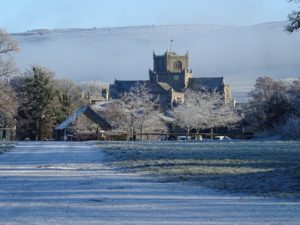
There has been a place of worship here in Cartmel since before the Norman Conquest.
For those who worked here, like my father,Walter Chadwick, the long-serving caretaker in the 1980s, Cartmel Priory represented far more than a historic building.
It was a living, breathing community hub—a place where daily maintenance work, guided tours, and wedding preparations told the ongoing story of a church that refused to fade into history.
Founded by a Legend
The church was founded in 1189 by Sir William Marshal on land recently granted to him by King Henry II.
He became a famous medieval figure who was later involved with the Magna Carta. William Marshal still has a bearing on the nation’s laws and governments to this day.
What the Caretaker Saw: Maintaining Medieval Mastery
Walter Chadwick’s responsibilities as caretaker went far beyond simple tidying.
Throughout the 1980s, his work involved keeping this 800-year-old structure “spic and span” while overseeing significant restoration projects that would ensure the Priory survived another century.

The decade saw major conservation work: re-roofing of the nave, rebuilding of the organ, replacement of lead on the tower, and extensive repairs to the heating system and windows.
These weren’t cosmetic updates—they were essential interventions that preserved the Priory’s structural integrity.
Cartmel Priory holds a special place in local history, and looking back, one memory always stays with me: my father taking me all the way up into the bell tower.
Standing high above everything else, you could truly appreciate the sheer scale and the immense, ongoing effort required to maintain such a magnificent building.
Founded as an Augustinian priory around 1189, the oldest sections of the church include the chancel, transepts, south doorway, and part of the north nave wall.
While local labourers helped with the heavy lifting, the masterwork was driven by travelling guilds of skilled craftsmen—talented architects who not only drew up noble, ambitious plans but stayed to ensure every detail was executed with precision.
Shaped in the form of a Greek cross, the church features a choir with side chapels, north and south transepts, and an aisled nave.
Over the centuries, a bustling network of monastic quarters grew right alongside the Priory Church, serving as the home and heart of the canons who lived and worked there.
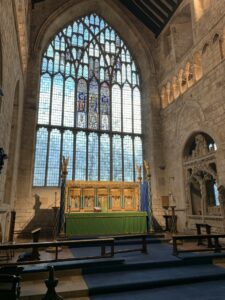
The huge east window nearly fills the east wall and contains some fragments of medieval glass rescued from earlier works.
The UK’s Most Unique Belfry Tower – Why Cartmel’s Tower Stands Alone
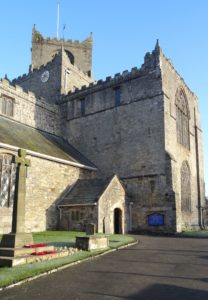
From the outside, notice something truly unusual: the diagonal belfry tower built at a 45-degree angle across the original low lantern tower.
This architectural quirk isn’t merely eccentric—it’s unique.
There is no other tower like it in the entire United Kingdom.
Why was it built this way? The reasons remain debated among historians, but the result is unmistakable: Cartmel Priory’s tower stands as a visual metaphor for the building itself—unconventional, resilient, and utterly distinctive.
The church clock is one of the oldest in Britain and still chimes on the hour.
The Art You Didn’t Know Was There
Josefina de Vasconcellos: The International Artist Hidden in Plain Sight
Few visitors to Cartmel Priory realise they’re walking among the work of an internationally renowned sculptor.
Josefina de Vasconcellos created multiple pieces of art throughout the church, yet most guidebooks barely mention her name.
De Vasconcellos, a celebrated artist whose work appears in galleries and public spaces worldwide, left her artistic fingerprints throughout Cartmel Priory.
Her work adds a contemporary spiritual dimension to this medieval space—a reminder that this isn’t a museum frozen in time, but a living sanctuary that continues to evolve.
Walter Chadwick remembered conversations with local historians about de Vasconcellos’ contributions to the Priory’s artistic heritage—a connection few modern visitors make as they pass her sculptures.
The Stories Nobody Tells
The Graves That Tell Tragic Tales
Walk through the church and churchyard and you’ll find graves marked with a haunting symbol: skull and crossbones.
These aren’t pirate memorials. They mark the final resting places of men, women, and children who drowned while attempting to cross the treacherous sands of Morecambe Bay.
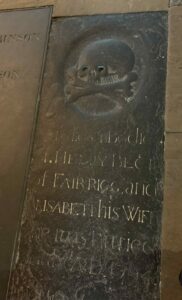
Visitors often ask about the meaning behind this striking emblem.
Its origins trace back to the crusades, when it was often just the skull and thigh bones of fallen soldiers that were returned home to England—giving rise to the symbol’s association with death.
Pirates later adopted it to terrorise the high seas, but by the seventeenth and eighteenth centuries, it had become fashionable among monumental masons for a very different purpose: not just to mark the death of the deceased, but to remind all who passed of their own mortality.
Look closely at the graves and you may also spot an hourglass, symbolising the passing of time, with wings to suggest the speed at which it slips away—and if shown on its side, a mark of untimely death.
For centuries, Morecambe Bay offered a shortcut between Lancaster and the Furness Peninsula.
However, those sands are deceptive—quicksand lurks beneath the surface, tides surge without warning, and mist can disorient even experienced travellers.
The graves at Cartmel Priory testify to the bay’s lethal power.
These aren’t abstract historical facts—they’re the real human cost of living on the frontier between land and sea.
Mary Lambert: A Major Figure Buried and Forgotten
Mary Winfield Lambert lies buried in Cartmel Priory churchyard, yet few visitors realise just how influential she was in shaping the local area.
Born in 1787, Mary inherited a considerable fortune from her grandfather and, in 1835, moved to nearby Boarbank Hall.
At a time when very few women independently controlled large estates, she managed her own affairs and used her wealth to improve the lives of local people.
Mary is widely credited with helping transform Allithwaite from a small farming hamlet into a thriving village.
She funded the construction of St Mary’s Church, provided a school for local children, and paid for a vicarage to support the parish minister.
Her generosity left a lasting mark on the community that can still be seen today.
Remarkably, Mary never married and devoted much of her fortune to charitable causes.
After her death in 1857, some family members challenged her wishes in court, but every one of her bequests was ultimately upheld and carried out.
Her grave in Cartmel Priory churchyard is a reminder that some of the most important figures in local history are not kings, generals, or politicians, but individuals whose vision and generosity helped shape the communities we know today.
The William Taylor Connection
The story of William Taylor offers a powerful lesson in inspirational teaching that resonates just as strongly today as it did centuries ago.
William Taylor, who became the beloved schoolmaster at Hawkshead Grammar School and inspired a young William Wordsworth to become one of England’s greatest poets, is buried in Cartmel Priory churchyard.
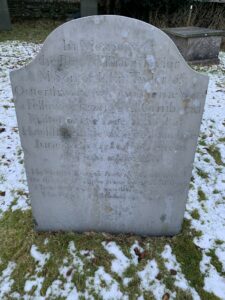
Yet this extraordinary connection—that the man who shaped Wordsworth’s literary genius rests here, in this small Cumbrian village—receives scant attention.
Taylor grew up on a farm nestled between the villages of Flookburgh and Allithwaite, and from an early age showed exceptional promise.
His talents took him to the renowned school at Hawkshead, considered at that time to be among the very best educational establishments in the North of England, and from there to Cambridge University, where he distinguished himself academically and carried off a number of prestigious prizes.

Though his academic background was in mathematics, it was poetry that truly captured Taylor’s heart.
When he returned to the Lake District at the age of 27 to begin his teaching career at Hawkshead Grammar School, he arrived with an impressive personal library of verse.
It was there that he encountered an eleven-year-old pupil who shared his passion, a boy named William who worked his way eagerly through every volume in Taylor’s collection.
That young pupil was William Wordsworth, and it was Taylor who first recognised the spark in him, encouraging him to put pen to paper and carefully nurturing his emerging voice as a poet.
Wordsworth himself recalled that his very first attempts at writing verse came as a school exercise set by Taylor on the subject of the summer holidays — a reminder that even the greatest writers have to start somewhere, and that behind every great talent there is often a great teacher.
Taylor’s influence on Wordsworth was so profound that he earned a place in one of the most celebrated poems in the English language.
In The Prelude, Wordsworth pays tribute to him across 28 remarkable lines, describing him simply and movingly as the honoured teacher of my youth.
It is a tribute that speaks to everything a good teacher can be — someone who sees potential, kindles curiosity, and helps shape a life.
Sadly, Taylor died young, while Wordsworth was still among the older boys at the school.
Years later, Wordsworth returned to visit his grave, and the emotion of that moment found its way into Book X of The Prelude.
That deeply felt passage will be displayed beside the headstone here, accompanied by an illustrated storyboard to help visitors understand the remarkable story behind it.
When the Priory Fought Back
Thankfully, the Priory was spared outright destruction during the Dissolution of the Monasteries in the 1530s — though not without consequence.
The monks of Cartmel were among those who refused to accept Henry VIII’s Reformation without a fight, joining the Pilgrimage of Grace and paying a terrible price for their defiance.
The rebellion had begun in Yorkshire in 1536, quickly sweeping through Lancashire, Cumberland and Westmorland.
That October, the Augustinian Canons of Cartmel, urged on by local laymen, boldly reoccupied their dissolved Priory and forced the reinstatement of their Prior — who wasted no time in fleeing to the safety of Lord Derby the moment he was able.
The Crown’s retribution was brutal. Four of the canons — Augustine Fell, William Panell, Richard Bakhous and John Cowper — were tried at Lancaster Assizes and executed, while three others escaped and two were acquitted.
But the punishment extended far beyond the monastery walls.
Ten local men, humble husbandmen, were hanged, drawn and quartered in March 1537: Robert Dawson, Peter Barwyk, Matthew Bateman, James Carter, John Blakhed, John Byglond, John Brokbank, William Crossefeld, William Byrkhed, and Gilbert Preston — ordinary men whose names are etched into this corner of history.
When Walter Chadwick walked these grounds in the 1980s, maintaining the very stones that witnessed this tragedy, he was walking through a church that had already survived the most existential threat to its existence.
Every repair, every restoration, represented not just preservation of wood and stone, but continuation of a 450-year-old miracle.
The 15th-Century Choir Stalls: A Clever Medieval Solution to a Long-Standing Problem
In the chancel of Cartmel Priory, you’ll find something truly remarkable: 26 original 15th-century choir stalls, each with an ornately carved misericord—a feature that reveals medieval ingenuity at its finest.

What exactly is a misericord? The term comes from the Latin misericordia, meaning “pity of the heart” or “mercy”—and these small wooden ledges, carved beneath the folding seats, were cleverly designed with mercy in mind.
During long religious services, monks and clergy would stand in the choir for hours.
When exhaustion set in, they could simply tip up their seat, and the hidden ledge beneath would provide support—allowing them to rest without appearing to sit down during worship.
It was a brilliant medieval solution: maintaining the appearance of standing devotion while giving weary worshippers a moment of relief.
The misericords at Cartmel Priory are particularly special because they’re original to around 1450, making them over 570 years old.
Each one bears intricate carvings of animals—a testament to the craftsmanship of medieval woodworkers and a glimpse into the creativity and humor that medieval artisans brought to even the most functional pieces of church furniture.
The 17th-Century Screen: A Gift from a Prominent Family
Surrounding these ancient choir stalls is an exquisite 17th-century screen, probably of Flemish workmanship, decorated with ‘the True Vine’ (representing Christ) and the signs of the PASSION—the events leading to His death.

This beautiful screen was gifted to the church by George Preston of Holker Hall, a prominent local landowner, adding another layer of artistic and social history to Cartmel Priory‘s interior.
Together, the choir stalls and screen create one of the most complete and authentic medieval-to-early-modern church interiors in the Lake District—a space where you can literally sit where monks sat 570 years ago, surrounded by art and craftsmanship that has endured through centuries of prayer and worship.
The Harrington Tomb
The Harrington Tomb is set into the Town Choir wall, containing effigies of Sir John (who died in 1347) and his wife Joan.

She belonged to the Dacre family, whose Coat of Arms includes a Shell, the badge of Pilgrims.
When Charity Outlived Its Donor: The Briggs Bequest of 1703
When Roland Briggs of Swallowmeier passed away on 27th November 1703, he left behind a lasting legacy for the poorest people of his parish.
He bequeathed £52 to the church wardens, to be invested so that the interest would fund bread distributed to the most needy householders every Sunday — forever.

It was a simple but profound act of ongoing charity, designed to outlive its benefactor by generations.
The gift was also deeply personal. Roland dedicated it to the memory of his beloved mother, Anna Briggs, who had died twenty years earlier on 21st March 1683, and who lies buried nearby.
In an age before welfare or social safety nets, this kind of private philanthropy could make a genuine difference to struggling families.
Roland also left 5 shillings to the church sexton, paid every Christmas from his lands at Addyfield, on one condition — that his grave should forever remain undisturbed.
It is a wonderfully human document; a son honouring his mother, a landowner caring for his community, and a man ensuring he would be remembered long after he was gone.
More than 300 years later, this act of charity continues to resonate—a reminder that generosity and memory are intertwined threads running through Cartmel Priory‘s story.
The Bullet Holes Story
Steeds, Soldiers, and the Sporting Legacy
Finally, don’t miss the bullet holes visible in the southwest door of the nave.
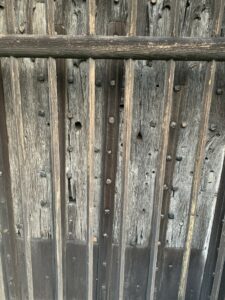
These holes are remnants from the 1640s, when Roundhead troops occupied the village and stabled their horses in the church.
The link between horses and Cartmel Priory goes back centuries.
Horse racing at Cartmel is likely to have started in the twelfth century by monks on mules.
Even to this day, as the racing season comes to an end, a special service is held at the Priory to show support for the racing community and what it brings to Cartmel.
The service is known as Steeplechase Sunday.
Staff and personnel connected to the racecourse take part in the morning service.
At the end of the service, the congregation and visitors gather on the Priory driveway to greet the arrival of the racehorse.
The vicar, Revd. Nick Devenish offers prayers, followed by refreshments provided by the racecourse.
Steeplechase Sunday has now become a firm marker of the Cartmel racing calendar.
These bullet holes are more than historical curiosities—they’re tangible evidence of a building’s refusal to be diminished by conflict, just as the community around it refused to let the Priory disappear during the Dissolution.
Visiting Information
Planning Your Cartmel Priory Visit
Opening Hours: 10:00am to 4:00pm Monday to Saturday
Admission: Free to enter
Guided Tours: Available
Photography: Generally permitted (check with staff)
Accessibility: The priory is DDA compliant

Don’t Miss:
✓ The unique 45-degree diagonal belfry tower
✓ Josefina de Vasconcellos’ sculptures throughout the church
✓ William Taylor’s grave in the churchyard
✓ The skull-and-crossbones graves marking Morecambe Bay drowning victims
✓ The 15th-century choir stalls with animal carvings
✓ Fragments of medieval glass in the east window
✓ The medieval church clock (one of the oldest in Britain)
Getting Married at Cartmel Priory
Cartmel Priory is one of the most romantic and historic wedding venues in Cumbria, and couples travel from across the country — and beyond — to exchange their vows beneath that magnificent east window.
Walter Chadwick spent many hours helping to prepsre the Priory for weddings and funerals—occasions when the building’s role as a community space became most poignant.
He understood firsthand how this 800-year-old sanctuary continues to mark life’s most significant moments.
If you are attending or planning a wedding here, Lothlorien Holiday Cottage makes the perfect base.
Our pet-friendly cottage, Lothlorien, is just a short drive from Cartmel in the quiet village of Kents Bank, Grange-over-Sands.
With two comfortable bedrooms sleeping up to four guests, a fully equipped kitchen, and a lovely secure garden, it gives wedding guests a relaxed and private retreat away from the bustle of the celebrations.
Whether you need somewhere to get ready in the morning, a peaceful place to return to after the reception, or simply a few days to explore the area around your special occasion, the cottage offers a warm and homely feel with no shared spaces and no hotel noise.
Dogs are very welcome too, so the whole family can come along and be part of the day.
Why Cartmel Priory Stands Alone
What Makes This 800-Year-Old Church Different From Every Other Lake District Attraction
While Lake District visitors flock to famous peaks and lakes, they often overlook Cartmel Priory—to their loss. Here’s what makes it genuinely unique:
The Only Diagonal Belfry Tower in the UK – That 45-degree architectural quirk isn’t found anywhere else in Britain. It’s an architectural anomaly that tells a story all its own.
International Artistic Heritage – Few Lake District buildings feature work by internationally renowned sculptors like Josefina de Vasconcellos. This isn’t just history—it’s living art.
The Teacher Who Shaped England’s Greatest Poet – William Taylor’s grave connects you directly to William Wordsworth’s inspiration. It’s a literary pilgrimage site few realize exists.
Unbroken Worship for 800+ Years – Through Norman invasions, religious upheaval, dissolution threats, and civil war, this building has continuously served as a place of worship. That’s extraordinary resilience.
The Hidden Stories – Drowning victims from Morecambe Bay, the Pilgrimage of Grace martyrs, Mary Lambert’s legacy—Cartmel Priory is a palimpsest of human stories.
A Living Community Space – Unlike many heritage sites that feel like museums, Cartmel Priory remains a working church where weddings, funerals, and Steeplechase Sunday celebrations happen. It’s history still being written.
The Caretaker’s Legacy
What One Man’s Dedication Reveals About Community
Walter Chadwick‘s years as caretaker weren’t glamorous work. Re-roofing projects, organ rebuilds, heating system repairs, window replacements—these were unglamorous but essential tasks that preserved the Priory for future generations.
Yet his work reveals something important: historic buildings don’t preserve themselves.
Behind every well-maintained church, every carefully restored window, every functioning heating system, there are people like Walter Chadwick who showed up, did the work, and made sure the building survived.
Walter’s willingness to show famous guests around the Priory, to help prepare for weddings and funerals, to take his family up to the bell tower to appreciate the full scale of what was being maintained—these were acts of stewardship.
They connected the building’s past to its present and future.
That spirit of stewardship continues today.
Cartmel Priory remains not because it’s protected by museum glass, but because the community continues to use it, maintain it, and care for it.
Conclusion
Why Cartmel Priory Deserves Your Time
Cartmel Priory isn’t famous like Windermere or dramatic like the Langdale Pikes.
It won’t take your breath away with sudden vistas or exhaust you with challenging climbs.
Instead, it invites you to slow down, to notice details, to read the stories written in stone and stained glass.
It asks you to imagine the monks who chanted here in 1189, the canons who defied Henry VIII and paid with their lives, the schoolmaster William Taylor who inspired literary genius, the ordinary people drowned in Morecambe Bay sands, the contemporary artists who continue to add beauty to this ancient space.
For 800 years, this building has witnessed human joy and sorrow, defiance and faith, preservation and renewal.
It has survived threats that would have destroyed lesser structures. It endures not because it’s encased in protective barriers, but because a community—from caretakers like Walter Chadwick to modern visitors like you—continues to care for it.
That’s what makes Cartmel Priory truly remarkable.
How to Book Kents Bank Holiday cottage in Grange-over-Sands
Booking Kents Bank Holiday Cottage is quick and simple. Just visit our website at kentsbankholiday.co.uk or give us a call at 07785944194. We’re always happy to answer your questions and help you find the perfect dates for your stay.
Our friendly team makes the whole process easy, so you can focus on your relaxing holiday cottage near Cartmel, and the Lake District.
❓ Frequently Asked Questions (FAQ)
1) Is Cartmel Priory free to visit?
Yes. Cartmel Priory is free to enter and welcomes visitors throughout the year. Donations are appreciated and help support the ongoing care and preservation of this remarkable historic church.
2) Why is Cartmel Priory famous?
Cartmel Priory is famous for its 800-year history, magnificent medieval architecture, unique diagonal tower, stunning stained glass, ancient choir stalls, and connections to important historical figures including William Marshal and William Wordsworth. It is also one of the few monastic churches to survive the Dissolution of the Monasteries largely intact.
3) How old is Cartmel Priory?
Cartmel Priory was founded in 1189 by William Marshal, making it more than 830 years old. Worship has taken place on the site for centuries, with evidence suggesting there was a place of worship in Cartmel even before the Norman Conquest.
4) Can you get married at Cartmel Priory?
Yes. Cartmel Priory is a popular wedding venue and couples travel from across the UK to marry beneath its magnificent medieval architecture and impressive east window. The Priory regularly hosts weddings, blessings, and other special services.
5) Who founded Cartmel Priory?
Cartmel Priory was founded in 1189 by William Marshal, one of the most influential knights and statesmen of the medieval period. The Priory was established for a community of Augustinian canons.
6) What is unique about the tower?
The tower at Cartmel Priory is famous for its unusual diagonal design. The upper section was built at a 45-degree angle to the original base, creating a feature that is believed to be unique in England and possibly the entire United Kingdom.
7) How long does a visit take?
Most visitors spend between 45 minutes and 1½ hours exploring the church, churchyard, historic monuments, stained glass, choir stalls, and unique architectural features. History enthusiasts could easily spend longer discovering the Priory’s many fascinating stories.
8) Is Cartmel Priory dog friendly?
Well-behaved dogs are generally welcome within the Priory, although restrictions may occasionally apply during services, concerts, or special events. It is always worth checking with the Priory before your visit if you plan to bring your dog.
9) Where can I park near Cartmel Priory?
Parking is available at Cartmel Racecourse (Cartmel Park), just a short walk from the Priory. Additional parking may be available at Cartmel Primary School on Sundays. Visitors can easily walk from the car parks into the centre of the village and to the Priory.
10) What are the opening times?
Cartmel Priory is typically open to visitors from 10:00am to 4:00pm Monday to Saturday, although opening times can vary due to services, events, and special occasions. It is always advisable to check the Priory’s website before travelling.