

Kirkby Stephen is set in a wonderful location. At its southern edge are the gorgeous grassy hills of the Howgill Fells and the vales of the Yorkshire Dales to the south-east.
To the south-west, the deep valleys and heathered solitudes of the Forest of Bowland and finally to the west, the aptly-named Eden Valley.
Hikers love Kirkby Stephen with the moors of the north Pennines forming a dramatic backdrop. It is also a significant stopping-off point for walkers undertaking Wainwright’s Coast to Coast walk.
For walkers doing the Coast to Coast, Kirkby Stephen provides a warm welcome and respite after a long, though not the hardest, slog over the moors from Shap.
Mallerstang Valley
A few miles to the south, in the Mallerstang Valley, is the source of the River Eden.
Here stand the ruins of Pendragon Castle, one of the dilapidated fortresses restored by Lady Anne Clifford.
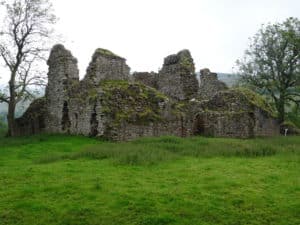
The town lies at the head of the Eden Valley and is set in some beautiful Cumbrian countryside between the Lake District in Cumbria and the Yorkshire Dales National Park.
However, the alleged connection with King Arthur is, to say the least, questionable. Closer to hand are the prehistoric earthwork known as Croglam Castle and the ruins of Lammerside Castle.

The ruin of Lammerside Castle (above) is on the west bank of the River Eden. All that can be seen are the remains of the fourteenth-century pele tower.
Although the population is small it indicates a village rather than a town. Kirkby Stephen clings to the status by its market charter of 1361. The market is still held every Monday.
For hikers walking the Coast to Coast route, Kirkby Stephen provides a welcome respite.
The late Alfred Wainwright pioneered the coast-to-coast long-distance walk and passed through the town with the naming of a fish and chip shop – Coast to Coast.
Many attractive old buildings are listed as being of historical importance.
Visit St Stephen’s Church and the Loki Stone
Kirkby Stephen can boast one of the finest churches in the country, St Stephen’s, dating from the 13th century.
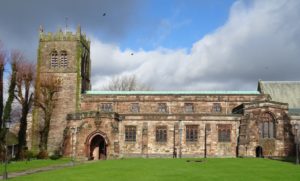
Facing onto the market square, the old cloisters of Kirkby Stephen form the main entrance to the parish church.
On market days they were long used as a butter market, with traders setting out their wares beneath the arches.
They were once edged with handsome ironwork railings, but these were taken away and melted down in the early years of the Second World War. They have never been replaced.
One charming wedding tradition lives on here. The cloisters are traditionally closed off until coins are tossed to the watching crowd, usually by the best man, and only then can the newlyweds leave the churchyard.

The cloisters were built in 1810 with money left to the town by resident John Waller, and they lead through to the red-sandstone church.
The cloisters doubled up as the butter market, as well as a splendid entrance that leads through to the red-sandstone church.
It was probably first founded in the 8th century and rebuilt towards the close of the 12th; it was completely pulled down again and rebuilt about 1230.
Furthermore, it underwent various alterations from the end of the 14th to the latter part of the 16th century.
Today’s church is like a small cathedral with a 16th-century bell tower.
The church contains many ancient relics, including the Loki Stone.

This metre-high block is decorated by a carved figure with horns, which is thought to be one of the few physical survivors of the time when Vikings settled in the area.
Walk to Nine Standards Rigg
The River Eden and Frank’s Bridge are a short walk from Market Place. A longer walk through neighbouring Hartley will take you high up into the fells to the mysterious Nine Standards Rigg.

Kirkby Stephen has a railway station that is one and a half miles from the town. It is 300 feet higher than the town centre on the Carlisle to Settle line.
❓ Frequently Asked Questions (FAQ)
1) Where is Kirkby Stephen located?
Kirkby Stephen is a traditional market town nestled in the Upper Eden Valley of Cumbria, on the edge of the Yorkshire Dales National Park and near the Lake District.
2) What are the top things to do in Kirkby Stephen?
Visitors can explore Stenkrith Park, cross the Millennium Bridge, visit the Steam Railway at Stainmore, and enjoy walks through Smardale Gill Nature Reserve and Nine Standards Rigg.
3) What local shops and places to eat are recommended in Kirkby Stephen?
Kirkby Stephen has independent shops like Buttercup and Church Gallery, plus great places to eat such as Coast to Coast Fish and Chips, The Mango Tree Indian restaurant, and The La’L Nook micro pub.
4) Is Kirkby Stephen on any famous walking routes?
Yes, Kirkby Stephen lies on Alfred Wainwright’s Coast to Coast walking route, a popular trail crossing Northern England’s National Parks.
5) What natural landscapes surround Kirkby Stephen?
Kirkby Stephen is surrounded by stunning landscapes, including the North Pennines Area of Outstanding Natural Beauty, Eden Valley, and nearby moorlands like The Howgills.
Where to Stay near Kirkby Stephen
Staying at Kents Bank Holiday Cottage in Grange-over-Sands? Kirkby Stephen makes an excellent day trip, taking around 45 minutes by car through some of Cumbria’s most beautiful countryside.
This old market town has many attractive nooks and crannies to explore and is only 45 minutes by car from Kents Bank Holiday Cottage in Grange-over-Sands.
To enquire about 07785944194 or contact us here.
How to Book Kents Bank Holiday Cottage
Booking Kents Bank Holiday Cottage in Grange-over-Sands is quick and simple. Just visit our website atkentsbankholiday.co.uk or give us a call on 07785944194.
We’re always happy to answer your questions and help you find the perfect dates for your stay.
Our friendly team makes the whole process easy, so you can focus on looking forward to your relaxing holiday in the Lake District.